Adobe Research Reveals Agentic AI Tipping Point: Australia and New Zealand brands lead on AI ambition
Monday, May 11, 2026
- New Adobe research highlights consumer appetite for agentic AI and AI-driven experiences, but transparency and human engagement are critical for adoption.
- Data integration and quality challenges prevent organisations from scaling agentic AI.
- Need for AI-powered speed and relevance intensifies with consumers giving brands just seconds to earn their attention, while generative AI continues to deliver significant gains to content speed and scale.
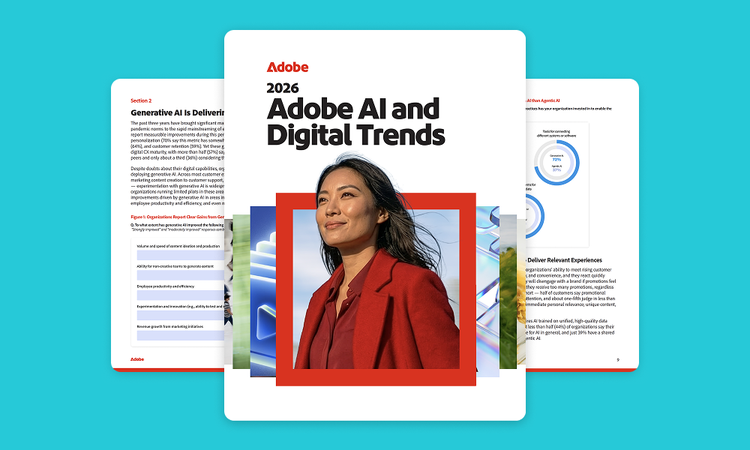
SYDNEY, Australia – 11 May 2026 — Adobe — the global technology leader that unleashes creativity, productivity and customer experiences through innovative tools and platforms — today released the Australia and New Zealand findings, from the Adobe 2026 AI and Digital Trends Report, its 16th annual global study based on the responses of 7,000 consumers and business leaders. The report examines how businesses are approaching digital transformation and AI adoption, and how consumers are responding to AI-driven and agentic experiences.
According to the report’s findings, consumers are open to agentic AI experiences, with almost a third (29%) saying they would interact with a brand’s AI agent if offered. Meanwhile, over two fifths (43%) say they have not yet considered the idea of a personal AI agent, and 27% say they are not open to personal AI agents at all, highlighting a large middle ground of potential converts.
Consumers are already incorporating AI into their purchasing and customer journeys. Two in five (41%) are using AI to search for personalised product recommendations, 39% are using AI for instant customer service or support and 23% are open to shopping via a virtual AI concierge.
As AI-powered experiences become embedded in everyday consumer interactions, this year’s research points to a pivotal moment in the evolution of agentic AI, giving brands a rare opportunity to shape adoption responsibly and build the orchestration, governance, and scale needed for sustainable growth.
The findings also reveal a growing disconnect between how consumers define AI success and how organisations actually measure it. While consumers judge AI experiences on trust, transparency, and whether their needs are met, many brands remain focused on efficiency gains and cost metrics, signalling a widening gap between consumer expectations and business priorities.
“Consumer behaviours are shifting across Asia Pacific, with AI already rising in brand discovery and now set to play a greater role in purchasing journeys. Many consumers are comfortable with agentic AI, but say adoption relies on defined, transparent contexts with options for human support,” said Duncan Egan, Vice President of Enterprise Marketing, Asia Pacific and Japan, Adobe.
“For many organisations, AI is already delivering meaningful improvements to experience delivery and customer growth. Early results from generative AI are translating into accelerated agentic adoption. However, while enthusiasm for agentic AI is high, most brands still need to build the data, governance and orchestration capabilities that will allow these efforts to scale.”
Trust and human connection will shape AI adoption
- The most important reassurances for consumers when using AI agents is the ability to switch to a human at any time (36%), followed closely by clear labelling (25%).
- As long as their needs are met, a quarter (25%) of consumers say they do not care whether a brand uses AI, but 39% would stop engaging if they discovered they were speaking to AI when they expected a human.
- More than two thirds (39%) of consumers say AI-driven personalisation often or always saves them time, and 42% say they feel convenient.
- 69% say AI-driven interactions should still feel human rather than robotic.
- More than two thirds (35%) would trust an AI agent to interact with a brand’s human representative on their behalf, and 23% are already comfortable with agent-to-agent interactions.
Enterprise AI readiness faces execution pressures
- Growing AI execution gap: Although 14% of brands have embedded agentic AI across their organisations for customer support, and 12% for brand discovery and search, most organisations still face significant adoption barriers, with 77% citing data integration and data quality as a key barrier to scaling.
- Data foundations building: Almost half (42%) say their data quality and accessibility are currently adequate for AI, and 44% report having a shared customer data platform for agentic AI.
- Ambition versus execution divide: Only 22% of Asia Pacific brands report strong alignment between executives setting the vision and practitioners executing delivery.
- Generative AI speed and scale gains: As brands continue to compete in an increasingly compressed attention economy, 76% of organisations say generative AI has improved the volume and speed of content ideation and production, and 74% say generative AI has enabled non-creative teams to produce content.
- Seconds-long attention window: Consumers now give brands mere seconds to earn attention, with more than half (57%) saying brands have two to five seconds to capture their interest, and just 19% deciding whether to engage in under two seconds.
- AI-powered search and discovery on the rise: Almost a fifth of consumers (17%) now cite AI-powered platforms as their primary research tool, ahead of brand websites and reviews, with AI most valued for answering questions, providing product recommendations, and troubleshooting. Meanwhile, almost two fifths of consumers (37%) now use AI assistants as a primary source at least some of the time, signalling a potential step change in how consumers research and buy online.
Australia/New Zealand leads the region in identifying high-value AI use cases
- 70% of Australia/New Zealand brands have identified practical, high-value AI applications, the highest in Asia Pacific, and three in four (76%) report increased speed and volume of content production due to generative AI. However, most Australia/New Zealand brands report data issues as an impediment to agentic AI implementation and only 22% of executives and practitioners describe themselves as strongly aligned, pointing to execution challenges as brands move from use case to deployment.
For more information read the Adobe AI & Digital Trends 2026 Report.
Methodology
For Adobe’s 16th annual AI and Digital Trends research, Oxford Economics, in partnership with Adobe, conducted global surveys of 3,000 executives and practitioners and 4,000 customers to better understand how organisations are leveraging AI to capture customer interest, build brand loyalty, and augment CX workflows — and how customers are responding to these changes. The surveys were fielded online and via computer-assisted telephonic interviewing (CATI) from October through November 2025, with the Asia Pacific sample including Australia and New Zealand (250 executives, 350 consumers), India (250 Executives, 300 Consumers) and Singapore (100 executives, 150 consumers).
About Adobe
Adobe (Nasdaq: ADBE) empowers everyone to create through industry-leading platforms and tools that unleash creativity, productivity and personalized customer experiences. For more information, visit www.adobe.com/au/.
© 2026 Adobe. All rights reserved. Adobe and the Adobe logo are either registered trademarks or trademarks of Adobe in the United States and/or other countries. All other trademarks are the property of their respective owners.